Physical Address
304 North Cardinal St.
Dorchester Center, MA 02124
Physical Address
304 North Cardinal St.
Dorchester Center, MA 02124

The stronger claim is narrower than the city’s branding. Copenhagen does not lead on every urban metric, and the article is better if it says that plainly. It leads because design, mobility, and planning have been integrated inside municipal policy for years, and that integration has survived updates in land-use law. The weaker claim is that the city has solved all of urbanism. It has not. The city formally acknowledged in a June 2025 council memo on its climate pathway that its original 2025 climate-neutrality target will not be met, and the same memo shows that car use still slightly exceeds bike use for all trips.
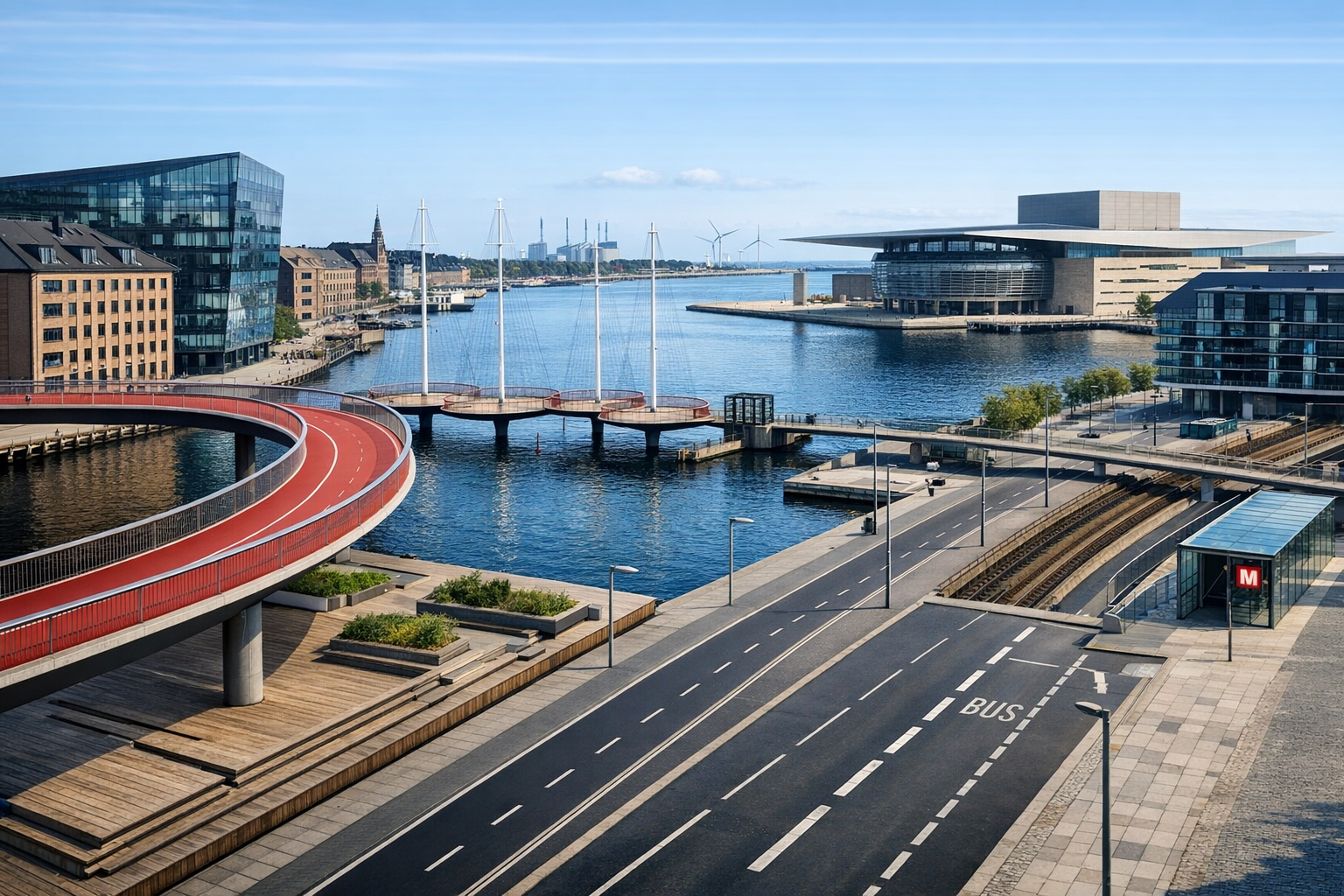
Copenhagen’s design edge rests on three pillars: statutory planning through Kommuneplan 2024, an architecture policy running 2017–2025 built around people-first design, and measurable cycling infrastructure with 45% of trips to work or education made by bike in 2023. The real lesson is not that Copenhagen is perfect. It is that the city has embedded design principles inside enforceable municipal rules rather than treating them as cultural ambition.
Many European cities have beautiful districts, successful waterfront renewals, or famous pedestrian streets. Fewer have pushed those values deep into the legal planning framework that governs what gets built next. That is where Copenhagen still holds an edge. It has spent decades turning human-scale design into ordinary municipal practice, and Kommuneplan 2024 is the latest expression of that continuity.
Urban design in Copenhagen is not a stand-alone design programme. It is a linked set of municipal tools covering architecture policy, land-use planning, mobility, climate action, and public-space management. The key instrument is not one flagship project. It is the combination of statutory planning and routine implementation. Kommuneplan 2024 sets the legal and regulatory framework for physical development. The architecture policy states the design principles. The climate framework ties mobility and emissions goals to the city’s growth model.
That structure changes what urban design means in practice. In many European cities, design quality is handled through project review, local exceptions, or isolated public-realm upgrades. In Copenhagen, core design choices are embedded earlier, inside municipal planning rules and long-term policy targets. The city’s role as UNESCO-UIA World Capital of Architecture 2023 helped advertise that model internationally, but the deeper story is not the title. It is the administrative system underneath it.
Kommuneplan 2024 is the clearest reason Copenhagen still stands ahead of many European cities. The city says the plan was adopted on December 12, 2024 and now sets the framework for physical development for the next 12 years. It is described as a package of main structure, guidelines, and regulatory frameworks for land use and development. That is the shift from admired urbanism to enforceable planning.
The statutory approach changes what gets approved and built. Under Kommuneplan 2024, design principles are no longer just advisory language attached to individual projects. They matter inside zoning, development review, and long-term land-use strategy. A new residential district, a street renewal, or a public-space upgrade now sits inside a current legal framework rather than relying only on design culture or political goodwill. Many European cities have design guides. Fewer have carried a mature people-first design doctrine into fresh statutory planning with a 12-year horizon.
The architecture policy for 2017–2025 explains Copenhagen’s design logic in direct terms. On the city’s architecture policy page, the framework is organized around three themes: “Architecture that tells,” “Built for Copenhagen life,” and “Responsibly designed.” The same page says the city aims to create buildings and public spaces that put people first. That language would be thin on its own. It carries weight because it has been paired with statutory planning and climate planning rather than left as a cultural slogan.
The three-theme structure is not decorative. “Architecture that tells” means buildings should communicate their purpose and context. “Built for Copenhagen life” means design should support the way people actually live in the city, from cycling commutes to public-space gathering. “Responsibly designed” means environmental performance and resource efficiency are built into the process from the start. Copenhagen’s advantage is not that these ideas are original. It is that they have been institutionalized.
The case for Copenhagen outperforming most European cities is strongest in relative terms, not absolute ones. The European Commission’s 2023 quality-of-life survey covers 83 cities and offers a more useful comparison base than tourism or branding lists. Copenhagen appears among the strongest cities for cycling use and urban satisfaction, which matters because cycling is one of the clearest measurable outputs of design working at city scale.
The field is also getting tougher. EIT Urban Mobility’s 2025 Copenhagenize Index note says all top 30 cities in the ranking now have an adopted cycling master plan or a mobility plan with a dedicated cycling chapter, and all have a dedicated team inside city administration working on cycling policy. That matters because Copenhagen’s institutional model is no longer a quirky Scandinavian exception. It is becoming the baseline among serious European peers. Copenhagen is still ahead, but the gap is narrowing.
This is the part that makes the article more credible, not less. Copenhagen’s climate-performance record remains strong, but the city itself says the original 2025 climate-neutrality goal will not be achieved. The June 2025 municipal memo says this had already become clear in 2022 and identifies two major reasons: underperformance in mobility-related reductions and delays in carbon capture and storage.
That miss reveals the limit of design-led urbanism when it collides with regional commuting, freight, and car dependence. Copenhagen has one of Europe’s strongest cycling cultures and has embedded people-first design into statutory planning. Yet it still fell short on climate neutrality. That does not cancel the design success. It shows that great urban design does not automatically solve every emissions problem. It also gives the article a cleaner verdict: Copenhagen’s lead is real on integrated planning, public space, and cycling, but overstated if readers treat it as proof that the city has solved transport or surpassed every European rival on every measure.
The most direct beneficiaries are residents who can rely on public space and active mobility as everyday infrastructure, not weekend amenity. The June 2025 council memo says 50% of all trips to work or school were still the city’s target for 2025, and that the actual figure in 2023 was 45%, compared with 42% in 2020. Those are not niche numbers. They describe a city where bicycle mobility is embedded in ordinary life.
The exclusions matter too. The same memo says bicycle share for all trips has been between 25% and 31% over the past fifteen years, while car use still slightly exceeds bike use for total trips. That gap is politically important because it points to users and trip types the model has not fully shifted. Outer-district households, regional commuters, tradespeople, freight movement, and residents with complicated trip chains do not fit neatly into the idealized bicycle-first story. Central Copenhagen reads as a success. Metropolitan movement still exposes friction.
Copenhagen’s current position did not begin with climate targets or branding campaigns. It grew out of long-term public-space thinking that treated street design as a behavioral tool. Strøget remains the classic example because it showed decades ago that reducing or removing traffic in central areas could change retail patterns, walking volumes, and the social use of public space. Jan Gehl’s work made that logic legible far outside Denmark.
That legacy still shapes what the municipality treats as normal. Many cities still handle high-quality public space as an exception attached to regeneration districts or special central squares. Copenhagen has had longer to treat it as ordinary practice. That does not make every district equal, and it does not eliminate trade-offs. It does mean the city entered the 2020s with deeper administrative memory than many rivals. Vienna and Zurich also perform strongly on human-scale urbanism, but Copenhagen’s version remains unusually centered on the relationship between public space, cycling, and planning doctrine.
The honest answer is that Copenhagen is genuinely ahead on the parts of urban design that are easiest to institutionalize: land-use coordination, public-space doctrine, cycling integration, and the habit of carrying design values across multiple planning cycles. That is more than branding.
At the same time, the city’s reputation can make the success sound broader than it is. Copenhagen is not the undisputed European leader on every urban metric, and its missed climate target proves that. The strongest version of the claim is not “Copenhagen wins at everything.” It is “Copenhagen still beats most peers where urban design matters most: inside the planning system itself.” That is a more precise and more defensible reason the city remains so influential.
The next phase is procedural, not symbolic. The June 2025 memo says Copenhagen is now working toward climate neutrality in 2030 through the EU Cities Mission framework, with a new climate action plan for 2026–2035. The city has already moved from one target architecture to another.
The design question is whether the statutory strength of Kommuneplan 2024 can now produce harder transport results than the previous cycle did. That will likely mean more than adding bike infrastructure. It will mean stronger coordination between land use, regional commuting, and street allocation. It will also mean performing after the branding moment fades. If Copenhagen keeps outperforming peers, it will be because the planning system still delivers measurable street-level outcomes after the image advantage becomes less novel.
On integrated planning, cycling, and public-space design, the evidence supports a strong yes. On every urban metric, no. The city still has a transport-emissions problem and did not meet its original 2025 climate-neutrality goal.
Kommuneplan 2024 is the clearest answer. It puts physical development, land use, and design inside a current statutory framework rather than relying on one-off projects or informal design culture.
Because it is one of the clearest measurable outputs of urban design. Mode share, street allocation, and protected-network quality show whether a city’s design doctrine actually changes daily behavior.
Its branding can sound broader than the actual results. The city remains strong on design and planning, but mobility underperformance was one reason the 2025 climate target was missed.
Parts of the model are already being copied. The harder part is not building one pedestrian street or one cycle track. It is sustaining alignment across land use, transport, and climate policy over multiple planning cycles.
Copenhagen is still outperforming most European cities where urban design matters most, inside the planning system itself, and that is what makes the city more than a branding success.