Physical Address
304 North Cardinal St.
Dorchester Center, MA 02124
Physical Address
304 North Cardinal St.
Dorchester Center, MA 02124

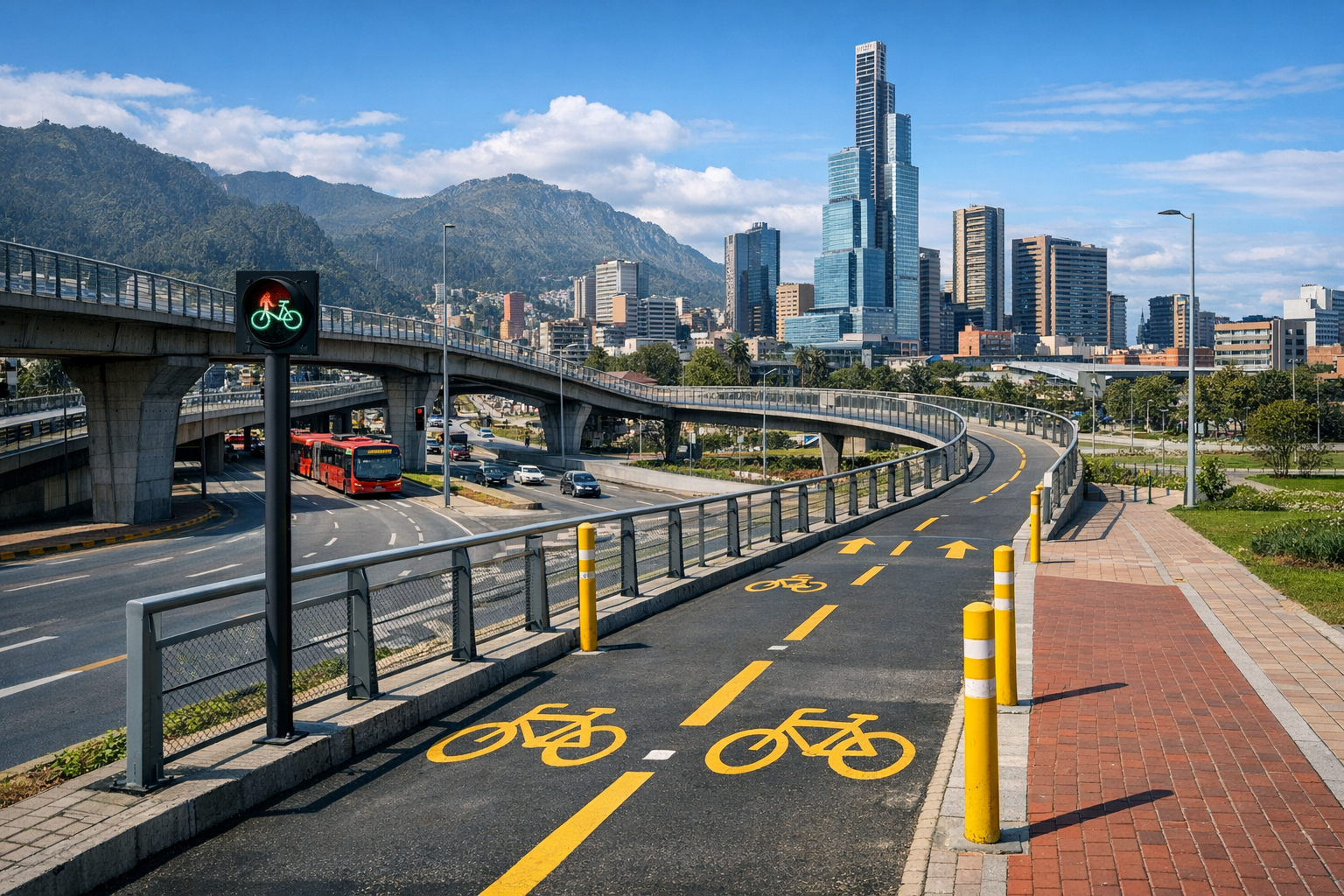
Bogotá is emerging as a global cycling leader because it is no longer just a famous Ciclovía city. It is becoming a daily cycling infrastructure city. Bogotá’s 2023 mobility survey counted 12.1 million daily trips across the city-region, and 70% were made by sustainable modes, including walking, public transport, and cycling, according to the city mobility survey release. That matters because Bogotá’s cycling reputation is often reduced to Sunday street closures, even though the stronger evidence now sits in daily access, network reach, maintenance, and public-bike expansion.
The case for Bogotá as a cycling leader is less about branding than system performance. The city combines a large protected bikeway network, mass weekly use through Ciclovía, expanding bike-share access, and continued public maintenance. The limits are visible too. Safety remains an open problem, and some headline metrics use different definitions or time windows. Even with those caveats, Bogotá is moving from symbolic status to measurable leadership.
Bogotá’s lead is clearest on access, not only on route length. The central metric used by ITDP measures how many residents live near protected bikeways, and the latest public benchmark puts the city at 51% within 300 meters of that network. The current phase of the story runs through 2024 to 2026, with fresh maintenance data, January 2026 participation records, and bike-share expansion across central and northern districts.
The fairest answer is yes, but with a specific definition of leadership. Bogotá is not leading because it has solved every cycling problem. It is leading because it has built cycling into metropolitan life through access, mass participation, institutional continuity, and recurring public-space use at a scale few cities outside Europe can match.
That distinction matters. Amsterdam and Copenhagen still set the global standard on safety perception, everyday cycling culture, and network comfort. Bogotá’s achievement is different. It is showing how a large Latin American capital can make cycling ordinary under tougher conditions: mixed traffic, social inequality, long commutes, safety concerns, and infrastructure-maintenance pressure. Bogotá’s leadership claim is strongest on reach and public legitimacy. It is weaker, and should be treated more cautiously, on proven safety outcomes.
Bogotá’s cycling system is not one program. It is a stack of institutions and street types. The Secretaría Distrital de Movilidad manages fixed cycle infrastructure. The Instituto Distrital de Recreación y Deporte runs Ciclovía, the weekly street closure system. Tembici operates public bike-share, which extends access to people who do not own a bicycle or do not want to ride the whole trip.
Those layers matter because they do different jobs. Protected bikeways support daily travel. Ciclovía builds habitual use and normalizes riding on major corridors. Bike-share reduces the barrier of ownership and can connect to transit and dense employment districts. Bogotá’s model is distinct because all three are active at scale. That is different from cities where cycling is led by one-off corridors or a leisure program without network depth.
A useful baseline sits in the city-region travel survey, where sustainable modes accounted for 8.44 million of 12.1 million daily trips in the 2023 survey. Cycling is part of that operating system, not a side activity.
The measurable shift is that Bogotá is no longer relying only on legacy reputation from the Enrique Peñalosa era or on the symbolic force of Ciclovía. A current international benchmark from ITDP puts the city at more than 540 km of protected cycle lanes, with 51% of residents living within 300 meters of one, according to ITDP’s 2024 comparison of cycling infrastructure. That metric is stronger than simple lane mileage because it asks where people live relative to the network.
The city is also still maintaining the system. Bogotá’s 2025 management report shows the Secretaría Distrital de Movilidad carried out maintenance on 25.4 km of cycle routes during the year, according to the SDM 2025 management report. That is a useful marker because it shows the network is being treated as an operating asset. Government material often refers to a broader ciclorruta network of more than 630 km, while ITDP’s figure refers to protected cycle lanes only. Those are different denominators, not conflicting counts.
The practical question is whether cycling works for routine trips, not just for a Sunday ride. Bogotá’s mobility survey suggests the city already has a large base for non-car travel. That changes the role of bicycle policy. In many cities, cycling infrastructure is treated as a niche climate project or a lifestyle amenity. In Bogotá, it sits inside a transport pattern where sustainable modes already dominate daily movement.
That makes protected access more valuable because it serves an established user base rather than trying to create one from scratch. A protected bikeway near home is not only an amenity. It can be the difference between a feasible daily trip and a trip that remains too stressful, too exposed, or too disconnected to attempt. Bogotá’s strongest lesson is that cycling leadership should be measured by how many people can realistically reach safe infrastructure, not only by how famous the city’s cycling image has become.
Bogotá’s current position cannot be read without Ciclovía, but it should not be confused with Ciclovía alone. The Instituto Distrital de Recreación y Deporte says the program has 50 years of history and serves more than 1.5 million users each week, according to the official Ciclovía page. That is unusual by international standards. Most open-streets programs are occasional events or seasonal pilots. In Bogotá, road closure for non-motorized use is a recurring civic institution.
The current scale is larger than the legacy narrative implies. Bogotá reported 2,426,363 participations on January 25, 2026, above 2,363,181 on January 18, according to the January 2026 city update on Ciclovía participation. Participation is not the same as commute ridership, and it should not be used that way. What it does show is repeated mass use of public streets without private cars, which helps explain why cycling has remained politically legible in Bogotá across administrations. Mexico City and Los Angeles have staged open-streets events, but neither has built a weekly institution at this scale. The cultural layer supports the transport layer.
The current rise is coming from measurement, maintenance, and reach. ITDP’s 2025 campaign report says Bogotá improved its People Near Protected Bikelanes metric by 14 percentage points during the campaign period, according to the Cycling Cities campaign report. That is more useful than a league-table label because it tracks access growth over time. The same indicator is also why Bogotá compares well with cities that have visible cycling brands but smaller catchment near protected lanes.
There is one reporting wrinkle. ITDP’s 2024 comparison said Bogotá’s access figure represented a 10% increase since 2021, while the 2025 campaign report puts the gain at 14 percentage points. The safer reading is that the later figure reflects a different measurement window or updated method. The discrepancy narrows the claim rather than negating the trend. Bogotá is improving on access. The exact pace depends on the reporting frame ITDP applied.
The city is also doing the slow work. Barrier and route upkeep are not glamorous, but they keep a network legible. A January 2026 Bogotá city note says 683 barriers were replaced in 2025, with 917 still pending out of 1,600 total. That points to a city still repairing and standardizing the system rather than treating cycling as a finished project.
Bogotá is not Amsterdam. The city does not have the same street geometry, income profile, safety environment, or land-use structure. It ranks as a leader because the relevant comparison is not romantic cycling imagery. It is delivery under difficult conditions. ITDP identifies Bogotá as the highest ranked Global South city on the protected-lane access indicator in its comparison set, based on the same 2024 benchmark. That places Bogotá in a different analytical category from cities that have bike lanes but weak population coverage.
The more useful comparison is not whether Bogotá feels like Copenhagen. It does not. The useful comparison is whether Bogotá is building the access conditions that allow cycling to become normal for large parts of the population. On that test, Bogotá is one of the most important cycling cities in the world because it shows that bike infrastructure can scale outside the wealthy European template.
No credible claim about cycling leadership can skip safety. Bogotá’s official observatory published the eighth edition of its 2024 road safety yearbook in July 2025, according to the Observatorio de Movilidad road safety notice. The summary headline on that release identifies motorcyclists as the principal victims, which matters because it places cycling inside a wider road-risk environment shaped by mixed traffic, enforcement, speed, and street design.
The public material available in that notice does not provide a clean cyclist-specific fatality or serious-injury figure. That should narrow the claim, not weaken the article. Bogotá can be a leading cycling city and still carry unresolved safety exposure. That is closer to the real policy picture in large Latin American metros. Protected access is improving. Maintenance is active. Usage is high. Safety remains incomplete and should be read as part of the performance test, not as an afterthought. Zurich and Tokyo offer a reminder that high everyday cycling performance depends as much on network calm and conflict reduction as on route supply.
Bogotá matters because it complicates the usual global cycling story. The standard narrative often starts with Amsterdam, Copenhagen, Utrecht, or Paris. Those cities are important, but they are not the only models. Bogotá shows a different path: a large, unequal, high-altitude Latin American capital using recurring open streets, protected bikeways, and public bike-share to make cycling visible and useful at metropolitan scale.
That makes the city especially relevant for places that cannot simply copy Dutch or Danish urbanism. Bogotá’s lesson is not that a city must be wealthy, flat, compact, and historically bike-oriented before cycling can matter. The lesson is that political legitimacy, access metrics, and maintenance systems can turn cycling from a symbol into public infrastructure. That is why Bogotá’s rise is more interesting than a simple ranking claim.
For residents, the impact is practical. Better access to protected bikeways can shorten daily trips, lower transport costs, and make cycling more realistic for people who would not ride in mixed traffic. Bike-share expansion can help residents make first- and last-mile connections without owning a bicycle. Ciclovía keeps the cultural habit alive by letting millions of people experience major roads without cars every week.
For planners, Bogotá offers a different kind of benchmark. The city shows that cycling leadership is not only about polished infrastructure in wealthy cities. It is also about reach, repetition, and institutional durability. A network that places protected routes near more residents can matter more than a smaller, more photogenic network in a tourist district. Maintenance data also matters because neglected barriers, broken surfaces, and inconsistent protection can quietly turn a formal bikeway into a weak one.
For investors and public agencies, the signal is that cycling is now part of Bogotá’s urban operating system. Public-bike expansion, route maintenance, and major weekly street use create demand for station management, safety improvements, mapping, wayfinding, maintenance technology, and multimodal integration. The opportunity is not just in building more lanes. It is in making the network safer, clearer, and more reliable for everyday trips.
The agencies behind the system are visible and distinct. The Secretaría Distrital de Movilidad manages infrastructure and survey work. The Instituto Distrital de Recreación y Deporte runs Ciclovía. Tembici adds shared fleet access. That split matters because it reduces dependence on a single program logic. If one administration slows capital expansion, another institution can still sustain ridership habits and public legitimacy through weekly use. That is one reason Bogotá’s cycling system has survived changes in political leadership better than many corridor-led schemes in other cities.
The next phase looks less like dramatic expansion than completion and quality control. The city still has 917 barriers pending replacement from a total inventory of 1,600, based on the January 2026 Bogotá update. Tembici’s public page describes the system as installing 300 stations, with wording that reads as build-out rather than a final audited count, according to the Bogotá bike-share operator page. Two near-term tests follow from that. One is whether asset maintenance keeps pace with use. The other is whether access expands beyond well-served central districts. Bogotá’s claim to leadership will hold if it keeps turning cycling from a celebrated idea into a maintained public service.
No. Ciclovía is still central, but the stronger current evidence is the protected network and how many residents can reach it. ITDP’s access metric and the city’s maintenance data point to a functioning daily mobility system, not only a weekly event.
That depends on the definition. ITDP refers to more than 540 km of protected cycle lanes. Bogotá government material often cites a broader ciclorruta network of more than 630 km. The narrower figure refers to protected facilities, which is why the numbers differ.
Public information from Tembici says the system is installing 300 stations. The wording indicates an expansion phase rather than a final audited count, so the safer reading is that Bogotá is building toward that scale.
No. The city’s observatory has current road safety reporting, but the source material does not provide a clean cyclist-specific risk figure. The available evidence supports a leadership claim on access, usage, and institutional continuity, not on safety being fully resolved.
Bogotá is proving that cycling leadership can emerge outside the wealthy European template. Its strongest advantage is not perfect comfort or complete safety, but scale: protected-lane access, weekly mass participation, bike-share expansion, and institutional continuity in a large Latin American capital.
Bogotá stands out because it has made cycling ordinary at metropolitan scale, and that is a harder test than producing a famous image.